
Each run has one folder, and that folder is the only place the programs meet. The experiment and its instruments write it; everything else reads it; the only thing written back in is a request to pause or stop.
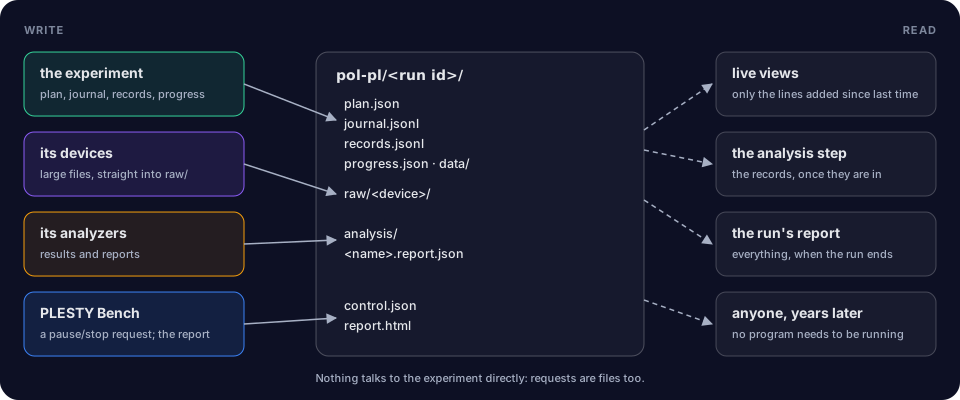
Every file is plain text or a plain array, and the logs are append-only, so a run needs no database or running program to be read — a folder copied onto a laptop years later still reads.
A plan of atomic steps
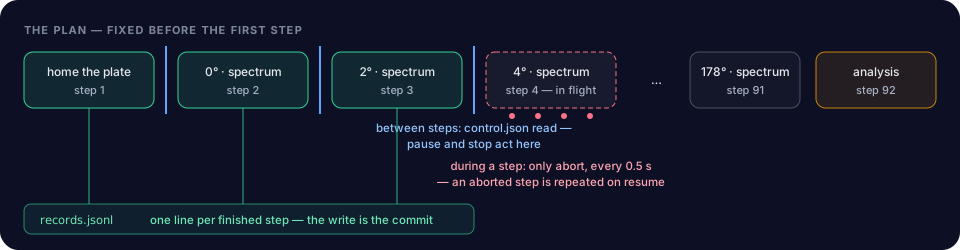
Before anything moves, the experiment writes down its plan — every step, in order — and never changes it. Each step is atomic: it finishes and its record is committed, or it counts as not done.
That one rule gives the rest:
- Stop anywhere, continue later. Resuming skips every committed step. The plan is content-hashed, so a configuration edited halfway is refused, not stitched in.
- Readers see only whole results. A line in
records.jsonlexists only once everything its step produced is on disk. - Control is a file too. PLESTY Bench's Pause, Stop and Abort write
control.json; the run acts on it at the next step boundary — or at once, for Abort, and that step is repeated on resume.
journal.jsonl beside the records says what happened — started, paused,
resumed, a note like "helium refilled" — while the records say what was
measured, each line naming the step and the call that produced it.
Large files never cross the network twice
A spectrometer or camera produces megabytes per step. Sending that through the
device server to the experiment and then to disk would move every file twice.
Instead the device writes its file straight into the run's raw/ folder,
and only the file's path travels back to be recorded.
For a device on another PC to do that, the run folder is on a shared data disk — and every PC sees that disk under its own path:
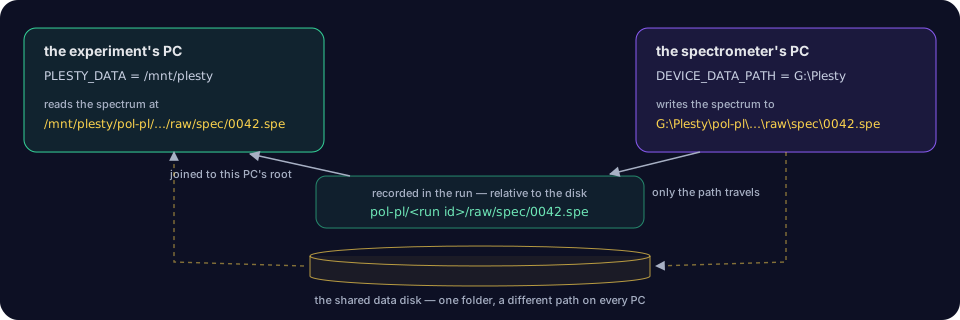
So no PC is told where another sees the disk. Each knows only its own
root, PLESTY_DATA — the shared disk as that PC mounts it — and every
recorded path is relative to it. A device writes only inside its bench's
folder on the disk (DEVICE_DATA_ROOT); Benches, Fleets & the
Share has the table of what each variable holds.
PLESTY Bench checks before each run that all benches really see the same
folder. A run on one PC whose devices save no files needs none of this.
Read next
- Analysis and Reports — what happens to the records once the measurement is in.